By David Villiers
Chair Airworthiness Panel
It has often been said that an aircraft is not airworthy unless the weight of the aircraft is exceeded by the weight of the associated paperwork. While not strictly true, paperwork is an essential part of aircraft maintenance, and despite the burden it can impose, it is a major aid in maintenance management and control, and therefore the airworthiness of our aircraft.
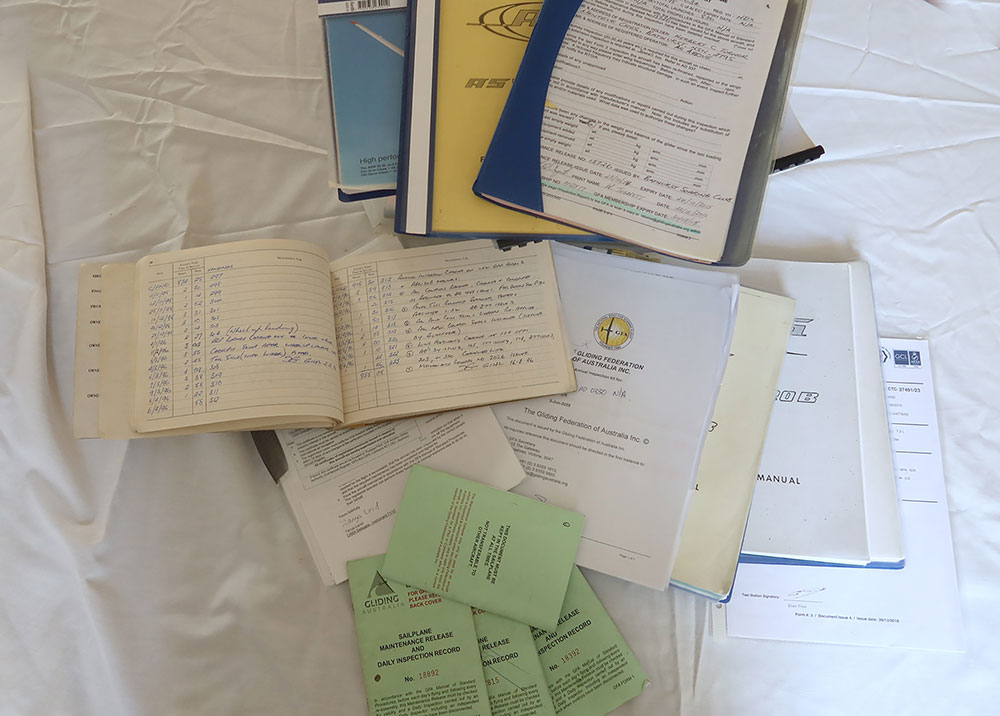
Of particular use in this regard is a glider’s Maintenance Release (MR). This small document is critical to the documentation of airworthiness. The MR is a working part of the aircraft’s logbook, and must be retained as part of the aircraft's records. The various sections of the MR contain all the information necessary to document an aircraft’s airworthiness and provides the means to ensure that all required maintenance is done on time. This is particularly true where club aircraft are flown by many different pilots, and worked on by many different inspectors – the MR provides the hand-over information passed from one pilot to the next, and from one maintainer to the next.
However, this only works if the MR is used correctly. There have been a couple of recent cases where maintenance required has not been entered into the appropriate pages of the MR, and as a result maintenance has been missed. This is sometimes the result of periodic maintenance (such as periodic re-greasing of l’Hotellier fittings) when the work has been done and signed off in the MR, but the task has not then been re-entered for the next scheduled recurrence. Other than l’Hotellier fittings, there are some aircraft which have recurring maintenance tasks that can come due more than once between annual inspections.
Form 2 Inspections
One maintenance task which needs careful scheduling is the Form 2 inspection itself. The GAus default system of maintenance is the Form 2 inspection. MOSP3 specifies that the Form 2 inspection is valid for 12 months or 250 hours time-in-service, whichever comes first. Not many gliders do over 250 hours in 12 months, but some do, particularly some club 2 seaters. If the 250 hour validity of the Form 2 is not entered into Part 1 of the MR, there is a significant risk that it will be missed and the aircraft will overfly the validity of its Form 2 and its MR.
However, a small number of gliders use their manufacturer’s system of maintenance, and this will have other requirements which must be complied with if the Registered Operator elects to comply with the manufacturer’s system rather than Form 2. MOSP3 provides guidance in Chapter 9. Obviously, any maintenance tasks scheduled must be entered into the appropriate section of the aircraft’s MR and signed off when completed.
Everyone who uses the MR, and that is all of us, needs to pay close attention and ensure that entries are made for all required maintenance. When recurring maintenance is certified, the next occurrence of that maintenance must be entered into Section 1 of the MR as Maintenance to be Performed.
Major vs Minor
Major and Minor Defects (Part 2) of the MR also need to be monitored carefully. Deciding whether a defect should be entered as Major or Minor can be difficult, and it is important that anyone entering a defect should err on the conservative side. In other words, unless you are certain the defect is Minor, it’s Major and should be entered into the MR as such. Seeking advice from someone with greater experience is always a great option. If anyone with the necessary Maintenance Authority disagrees with your decision, they can sign off the Major and re-enter it as Minor, thereby taking responsibility for the entry.
Finally, Part 3 of the MR is where the majority of problems occur. Arithmetic errors in adding hours and minutes, as well as transposition errors (where the order of two or more digits are reversed) can result in significant, cumulative errors in the totals of hours and landings. The errors can result in maintenance being missed or called out more often than needed because the error in Part 3 is used to decide if maintenance listed in Part 1 is required or not.
A simple solution to the addition problem is the use of a smart-phone app that adds hours and minutes. Any number of them are available on the web. At the end of a long, hot, sweaty day on the airfield, mental arithmetic is no-one’s strong point!
Foreign Objects
Recent defect reports (SDRs) have raised the issue of foreign objects found in aircraft, sometimes long after the item was lost. These have included a metal valve cap found jamming an aerotow release, flight controls restricted by a ‘spare’ M6 nut, and various tools found in aircraft during maintenance.
Apart from the jamming and control restrictions, there are concerns about where the spare hardware comes from. In the case of the M6 nut, no bolt was found to be missing its nut or washer (no washer was found either) but I doubt that this was much comfort to the inspector who had to sign off the defect – the nut could have come from anywhere in the aircraft, or it could have fallen out of a pocket or tool kit. There can be no certainty that something has not been missed.
The metal valve cap in the release is another issue. There is no direct path from the cockpit to the release once the release cover is installed, and why there would have been a loose valve cap in the cockpit in any case is a good question.
The only solution to these problems is maintenance hygiene – keeping the workspace sterile.
Controlling Your Hardware
One way to control loose hardware is to use a receptacle of some sort to contain all hardware and fasteners removed during a job. This can be as simple as a small zip-lock bag or bags to hold the bits and pieces. Another solution is a plastic box divided into cells into which the various parts can be placed so you know which parts came from where. Placing fasteners on the seat cushions or in the side pockets may be convenient, but makes it very easy to lose things when they are tangled up with the cushions and harnesses. Having to pull the seat pan out looking for a part that can no longer be found in the cockpit is a major inconvenience.
Tools left in aircraft is a perennial problem and one that affects all sectors of the aviation industry. The only solution is professionalism. Anyone who works on aircraft needs to keep track of their tools, both by knowing what should be in their tool kit after the work is completed, and managing the number and location of tools in the aircraft.
One good practice, although sometimes difficult to implement, is to never put a tool down inside an aircraft.
Another is to check the contents of a tool box or tool kit after finishing a job to make sure nothing is missing. That can be easier said than done, but tools like Allen Keys and small spanners often come in sets where a missing tool is immediately obvious. Big toolboxes full of accumulated tools, bits of wire, loose spare hardware of uncertain origin, and special one-off tools created for specific tasks can be impossible to check. (How many Phillips head screwdrivers did I have in there again?) A smaller tool box with the essential tools that can be checked is a good idea. All other tools and the odds and sods can live in another box that is only accessed when needed.
Whenever we’re working on aircraft, we have always to be conscious of the hazards involved with foreign objects, loose tools and so on. Conscious effort and self discipline is required to manage these risks and everyone who works on gliders has a part to play.